
Most blogs that tackle the topic of SEO and public relations read like a checklist from 2016:
Use keywords
Add alt text to images.
Ask for backlinks.
All true — and all table stakes. What they rarely do is explain why the combination works at a deeper level, or show you what it looks like when it actually moves the needle.
We’ve seen the power of a seo public relations strategy firsthand with our clients, with measurable results unlikely to be seen from traditional SEO alone. This piece breaks down exactly how PR and SEO intersect, why it matters more than ever, and what a high-impact combined strategy actually looks like in practice.
Nata PR is an award winning PR agency based in Montreal, servicing Canadian and international clients. With over 20 years of experience in the PR industry, we are uniquely positioned to speak to how PR has changed from 1990 to 2020, and what brands need to do to build their presence online- not just on Google, but across all search channels.
Prefer to listen? Check out our Podcast Episode with Jordanne Erichsen, Head of SEO at Outsmartlabs and Founder of Express Voice Studio.
Key Takeaways
PR backlinks from authoritative media outlets carry more SEO weight than almost anything traditional link-building can produce.
Every press release, byline, and media placement is also an SEO asset — if your team knows what keywords to build around before the campaign launches.
PR raises your domain authority ceiling; traditional link-building builds the floor — you need both running simultaneously to move the needle fast.
First, why does domain authority matter so much?
Domain authority (DA) is a score — developed by Moz and used widely across the industry — that predicts how likely a website is to rank on search engine results pages. It runs from 1 to 100, and it is primarily influenced by the number and quality of websites linking back to yours.
Here’s the thing about DA: it’s extremely hard to move quickly with traditional SEO tactics alone. You can optimize every page on your site, write excellent content, fix your technical issues — and your DA will improve slowly over months and years. What accelerates it dramatically is earning backlinks from authoritative, high-DA publications. And that is exactly what a well-executed PR strategy does.
When a journalist at a respected outlet covers your brand and links to your website, you’re not just getting press. You’re getting a credibility signal that search engines trust. The more authoritative the outlet, the more powerful the signal.
The real difference between PR backlinks and typical link-building
Standard SEO link-building tends to involve tactics like guest posts, directory listings, or outreach to smaller niche sites. These are legitimate and useful. But they rarely earn links from major publications — the ones with DA scores in the 70s, 80s, and 90s.
PR gets you those links. A feature in a regional business publication, a quote in an industry trade outlet, a contributed piece in a recognized trade magazine — these are the kinds of placements that traditional link-building can’t replicate, because they’re earned through relationships and newsworthiness, not through transactional exchanges.
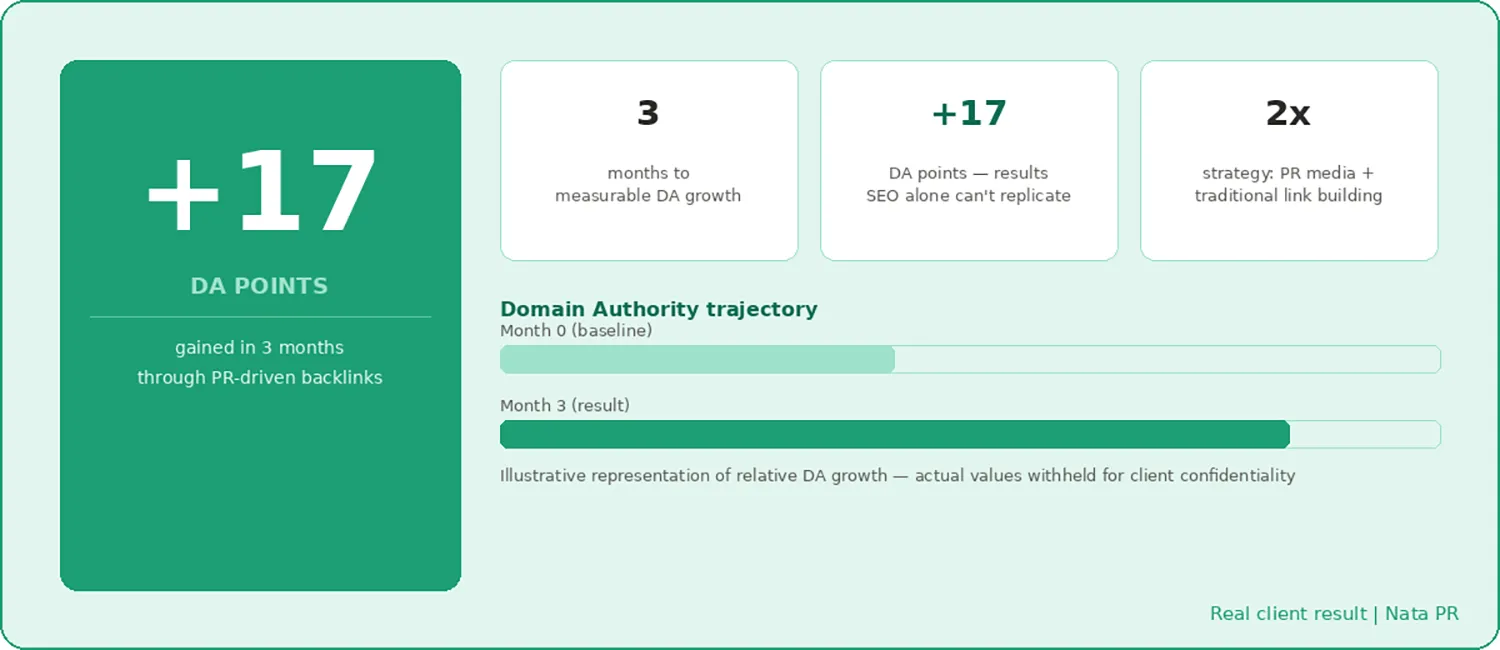
The combined approach — PR placements for high-authority backlinks, paired with traditional link-building for volume and consistency — is what produced that +17 DA jump for our client in 90 days. The two strategies reinforce each other: PR raises the ceiling, traditional link-building builds the foundation.
Bad Backlinks: Key Digital World Knowledge for Every Brand
Not all backlinks help your site. Done wrong, link building doesn’t just fail to move your rankings — it actively damages them, and in some cases the damage takes months to undo.
Google’s Penguin algorithm, first launched in April 2012, was built specifically to target manipulative link-building practices. Now running in tandem with the core algorithm, it assesses links in real-time — meaning there’s no waiting for a periodic refresh. The impact of bad links can be felt almost immediately. Here’s what “bad” link building looks like in practice:
- Buying links from low-quality or irrelevant sites.
There’s an important distinction that most generic SEO advice glosses over: purchasing a backlink isn’t inherently the problem. The problem is purchasing a backlink from the wrong kind of site. Link farms, private blog networks (PBNs), and low-DA spam sites that exist primarily to sell placements — rather than serve a real audience — are exactly what Google’s detection systems are built to identify. A well-placed link from a legitimate, high-authority industry publication is a very different thing from a bulk order off a link marketplace. The risk isn’t paid link building as a category. It’s paid link building without the tools and expertise to evaluate what you’re buying. - Irrelevant links.
A link to your B2B software company from a gambling site or a foreign-language directory might technically count as a backlink, but it reads as suspicious to search engines. Penguin specifically targets manipulative link-building practices including link farms, private blog networks, and low-quality directories with little editorial oversight (Digital Thrive ). Topical relevance matters — links should come from sites that exist in your content ecosystem, not from wherever a cheap agency could cheaply place them. - Over-optimized anchor text.
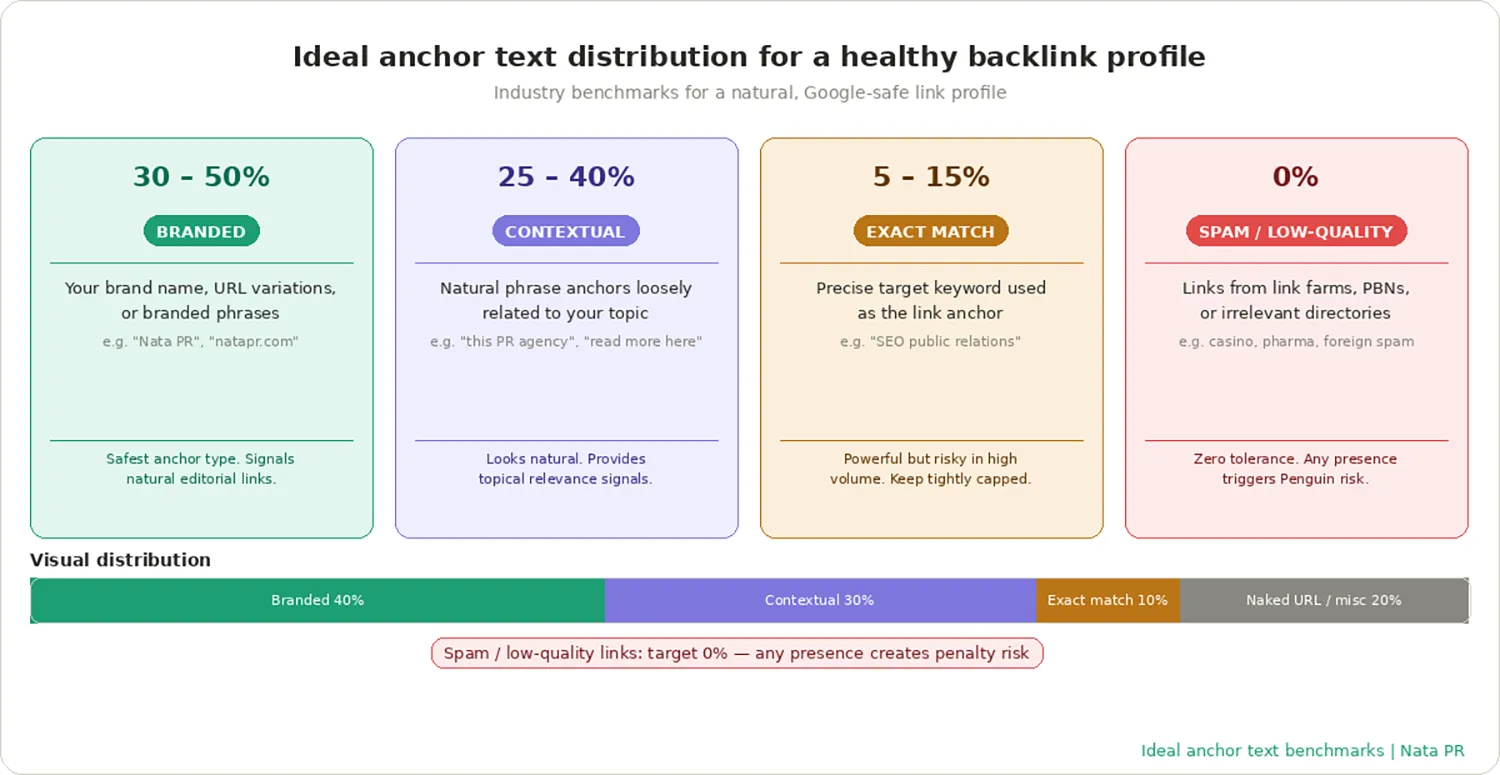
If a disproportionate number of your backlinks use the exact same keyword phrase as anchor text, it signals to Google that those links were placed artificially. Sites that rely on manipulative or low-quality backlinking strategies can see their organic rankings decline, in some cases because of specific keyword groups that have been dramatically over-optimized. A knowledgeable SEO team will continue to run regular anchor text evaluations to ensure your website has a healthy percentage of brand anchor texts, exact match, and contextual anchor texts from backlinks.
Naturally Aligning SEO and PR (and where most brands miss the opportunity)
The overlap between PR and SEO is bigger than most teams realize. Here are the areas where integration pays off most:
Press releases and media coverage.
Every press release you distribute and every article that covers your brand has the potential to appear in search results. When those materials are optimized with relevant keywords and include links back to your site, you’re compounding the value of every media hit. A placement that earns a link from a DA-80 publication does double duty: it builds brand awareness and it moves your search rankings.
Thought leadership content.
Bylined articles, expert quotes, and contributed pieces are natural homes for keywords your brand wants to rank for. When a PR team develops a thought leadership calendar with both editorial placement goals and keyword targets in mind, every piece of content serves two masters simultaneously.
Brand mentions.
Even unlinked brand mentions — where your company name appears on a reputable site without a hyperlink — contribute to search engine trust signals- now more than ever with various AI platform algorithms using total brand and category mentions as a ranking factor. Getting your name into authoritative publications consistently, which is PR’s core function, builds that credibility over time.
Brand reputation management.
When a brand faces negative press, the first place most people look is Google. A PR strategy that controls the narrative also controls what surfaces in search results, especially when positive placements are SEO-optimized to outrank negative coverage.
Know How To Shape Your PR Content: Use an SEO Team for Consulting on Keywords
Define target keywords before any PR campaign launches.
Before writing a press release, pitching a story, or placing a byline, know the two or three phrases your brand most wants to rank for. These should come from a conversation with whoever manages your SEO. Don’t have someone?
Find a trusted SEO freelancer or agency who will work with you on a consultation basis. This will allow you to pay for your keyword research and for check-ins with an SEO specialist to continue building a PR strategy that is SEO informed.
Three things your PR team can do right now to improve SEO
You don’t need an SEO specialist on your team to start capturing these benefits. Here’s what PR professionals can do directly:
1. Always ask for the link.
When a reporter covers you, or when you place a contributed article, make sure there’s a link back to your website in the copy. This sounds obvious, but it often gets overlooked in the excitement of securing a placement. A mention without a link is valuable for brand awareness; a mention with a link is valuable for brand awareness and your search rankings. Build the ask into your standard follow-up process.
2. Optimizing Links
Your press releases, if hosted online, can rank in search. Your contributed articles, your interviews, your podcasts — if they live on the web, they benefit from keyword-conscious writing. This doesn’t mean stuffing keywords in awkwardly. It means writing with search intent in mind: what would someone type into Google that you’d want this piece to answer?
*This is where having an SEO team working with your PR Agency is ideal. Find a PR agency that already has those relationships (Like Nata PR!) or ask for your SEO team to be integrated into meetings with your PR team.
3. Use anchor text intentionally in your own content.
When your team writes blog posts, press pages, or any owned content that links to other pages on your site or to media coverage, be descriptive with the link text. “Click here” tells search engines nothing. “Read our coverage in Forbes on AI-driven PR strategies” tells search engines exactly what the linked page is about. This is a small habit that compounds over time.
Data Driven Insights: Nata PR’s Digital PR Campaign Drove a +17 DA Increase in 3 Months
The client result we mentioned — +17 DA in three months — didn’t happen because someone got lucky with a viral story. It happened because the work was structured deliberately.
The strategy combined two tracks running in parallel. The first was earned media outreach informed by the clients’ SEO priorities: pitching stories, securing placements, and placing thought leadership content in publications with meaningful domain authority via a story that enforced their chosen keywords. Every placement was tracked not just for reach and impressions, but for whether it generated a backlink. The second track was traditional link-building: identifying relevant directories, industry associations, and partner sites where a link made genuine sense, and earning those placements systematically.
Neither track alone would have produced that result in 90 days. Together, they created a backlink profile that search engines read as a rapid, credible increase in site authority.
The question most brands should be asking
If your PR team and your SEO team are working in separate silos — measuring different metrics, setting different goals, and rarely comparing notes — you’re almost certainly leaving results on the table. The brands that win in search over the long term are the ones that treat earned media not just as a reputation tool, but as a link acquisition strategy.
The infrastructure for this integration already exists in most organizations. It doesn’t require new tools or new hires. It requires a shared keyword list, a shared media target list, and a habit of asking “does this placement include a link and reinforce our SEO/GEO priorities?” every single time.
Want to see what this could look like for your brand visibility?
Nata PR has built PR strategies that move both reputation metrics and search rankings. If you’re curious what a combined PR and SEO approach might look like for your specific business — and what realistic outcomes you might expect in your first 90 days — we’d be glad to walk you through it.
Book a free strategy consultation →
Nata PR is a public relations agency specializing in earned media, brand positioning, and integrated SEO PR strategy. Visit natapr.com to learn more.